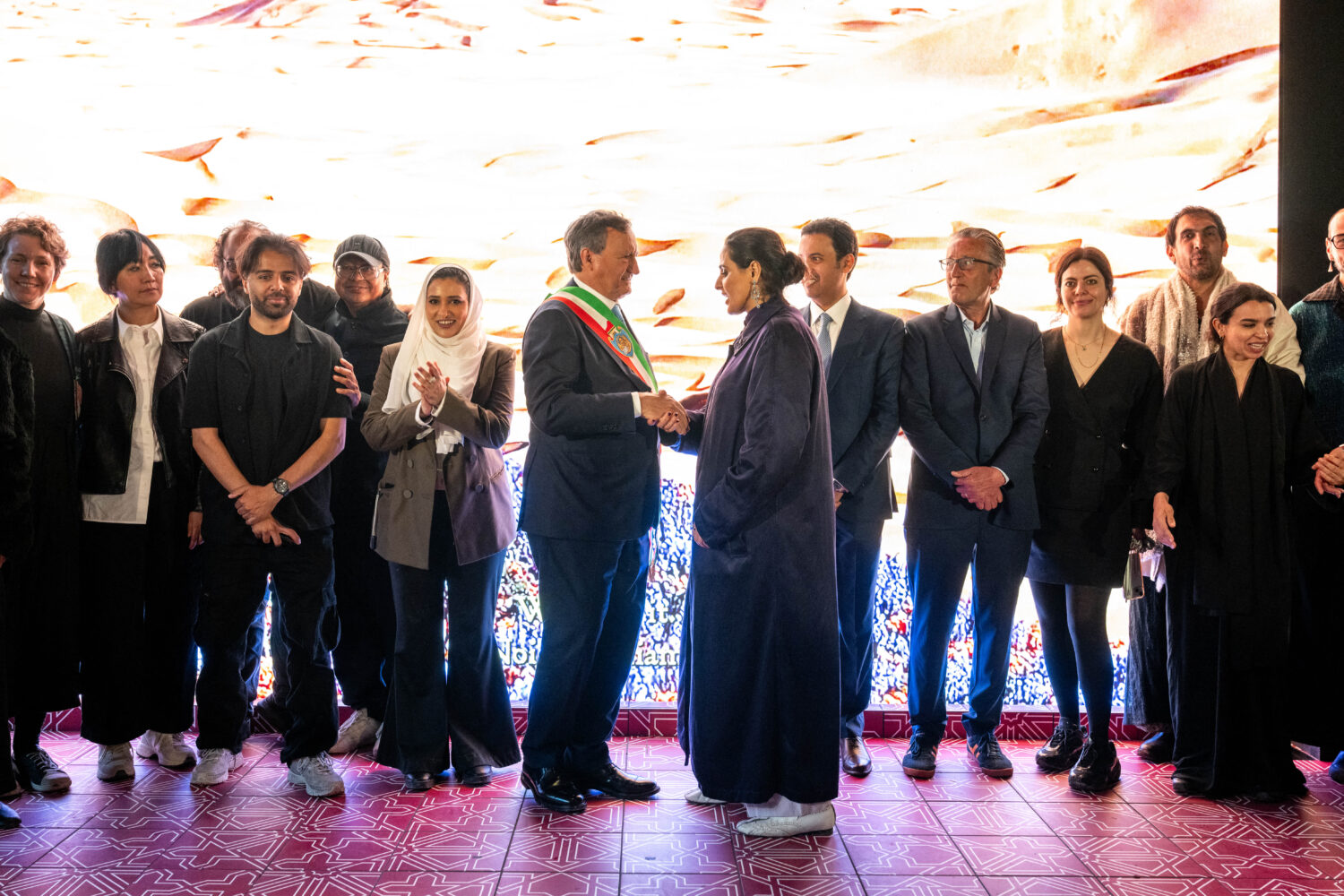
Presented on the site of the future permanent Qatar Pavilion, a gathering of remarkable people features a tent-like structure designed by Rirkrit Tiravanija to serve as a place for cultural exchange, supporting different forms of participation and artistic intervention.
Among these are screenings of an experimental narrative film by Qatari-American artist Sophia Al-Maria, entitled DAMAR TV (2026), and Jerrican (2026), a large-scale sculpture by Kuwaiti-Puerto Rican artist Alia Farid. More than a dozen activations will unfold at the Pavilion between its inauguration and the close of the Biennale Arte 2026, pairing live performances organised by Lebanese artist Tarek Atoui with a culinary programme of Middle Eastern cuisine designed by Palestinian chef Fadi Kattan.
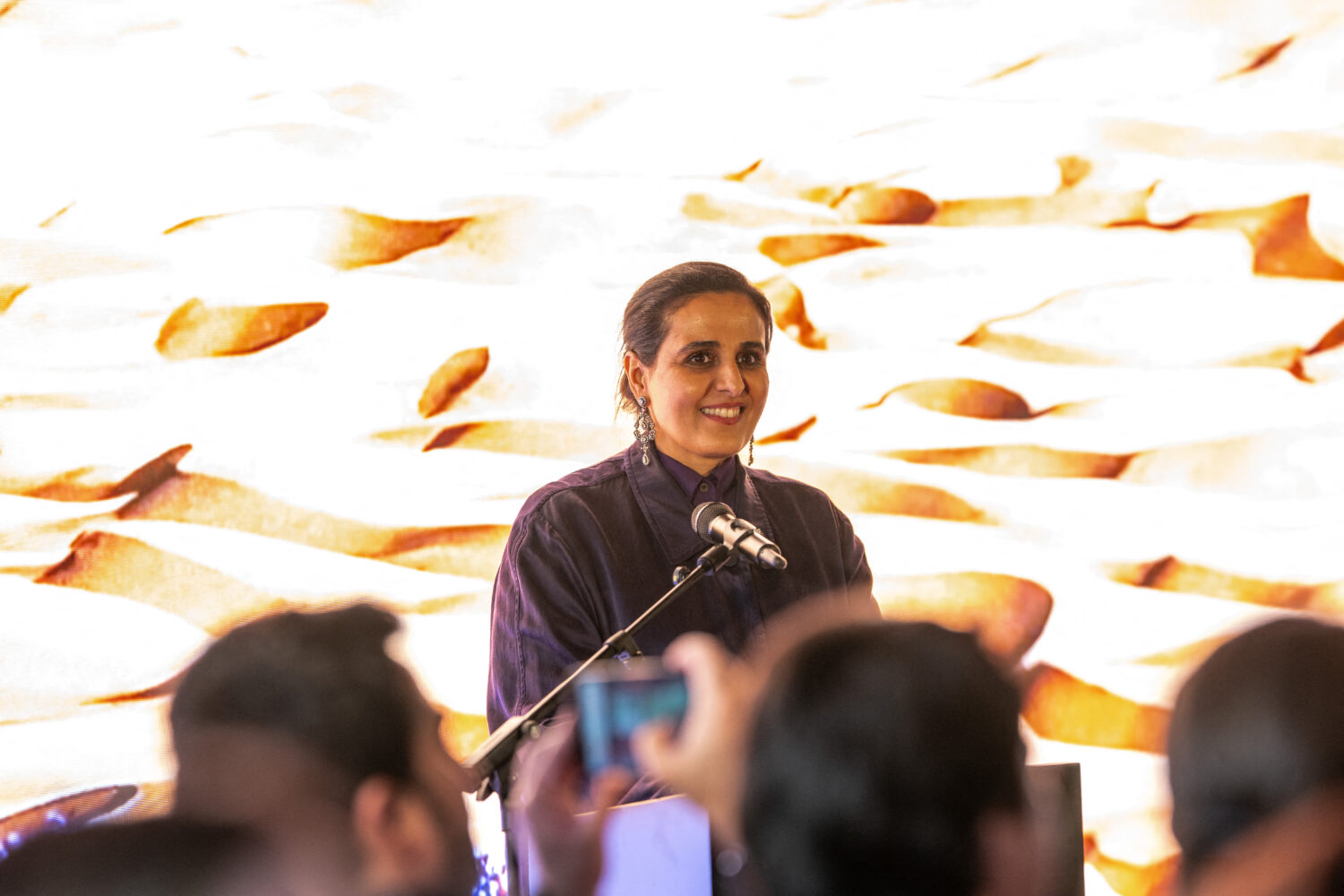
Her Excellency Sheikha Al Mayassa bint Hamad bin Khalifa Al Thani said, “Like the permanent Pavilion designed by Lina Ghotmeh that we will soon build on this beautiful site in the Giardini, untitled 2026 (a gathering of remarkable people) celebrates Qatar’s tradition of openness and hospitality while showcasing creativity not only in our nation but across the Arab world. In this time of conflicts and challenges, it is more important than ever to uphold the power of culture to bring people together and affirm our shared humanity. I congratulate our co-curators and all the artists on realising such an imaginative and welcoming experience, which will be alive with the visions, sounds, and even flavors of our far-reaching Arab cultures.”
The exhibition will feature artists, musicians, poets, and chefs, all drawing on the diverse cultures of the Arab world. Improvisational collaborations arranged by Atoui will include musicians responding to field recordings captured by Atoui from Qatar’s coastline and by the Lebanese sound recorder Paul Matar. Chefs and mixologists from across the Middle East and North Africa will offer cuisine that sits at the intersection of preservation and innovation, with menus often centred on a single ingredient to trace the cross-cultural impact of migration and trade. A full schedule of activations is below.
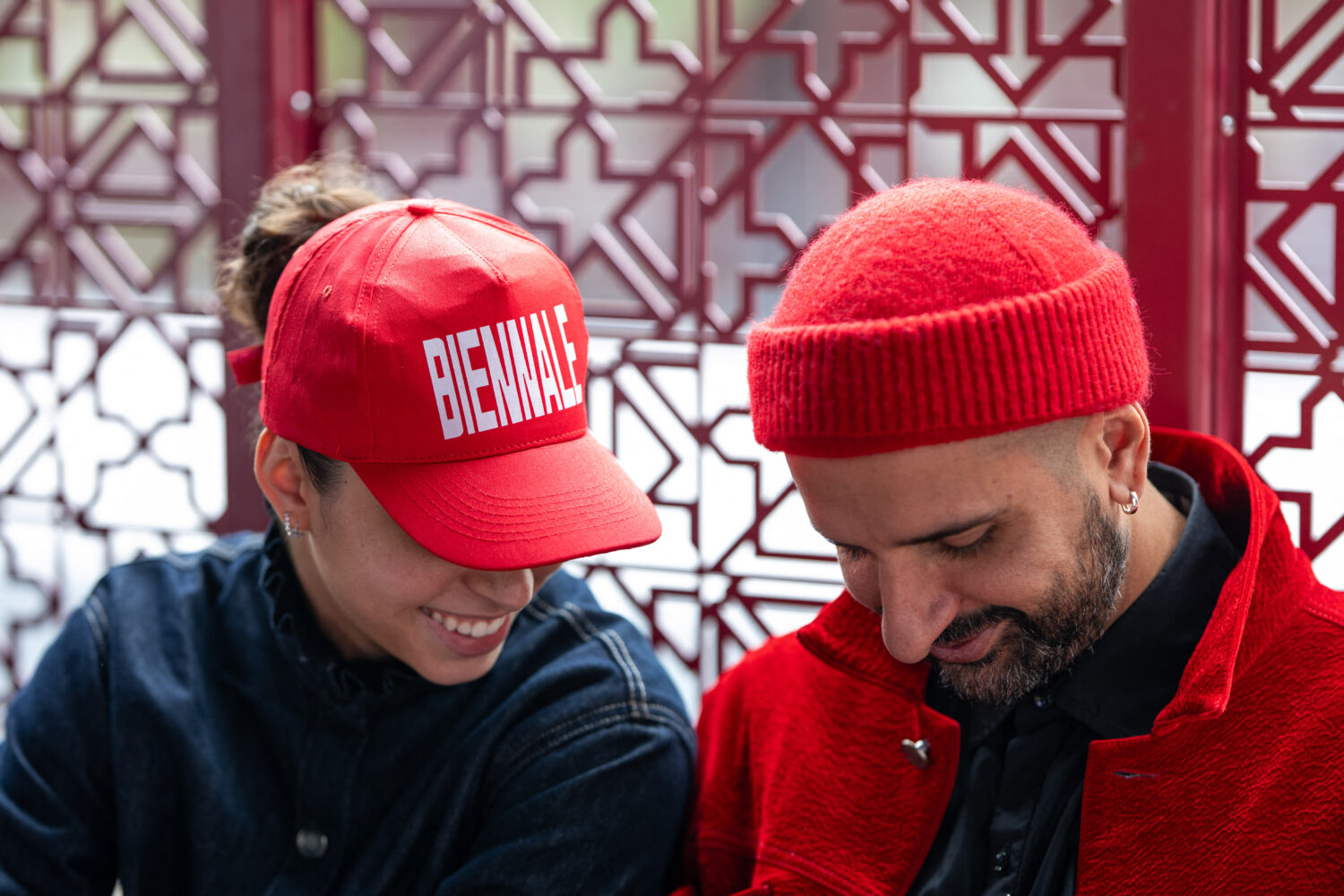
Modelled after Qatari gathering spaces, Tiravanija’s maroon-coloured temporary structure features a “scrambled” mashrabiya pattern, a traditional Islamic architectural element featuring intricate, latticed wooden screens, primarily used for privacy, passive cooling, and natural lighting.
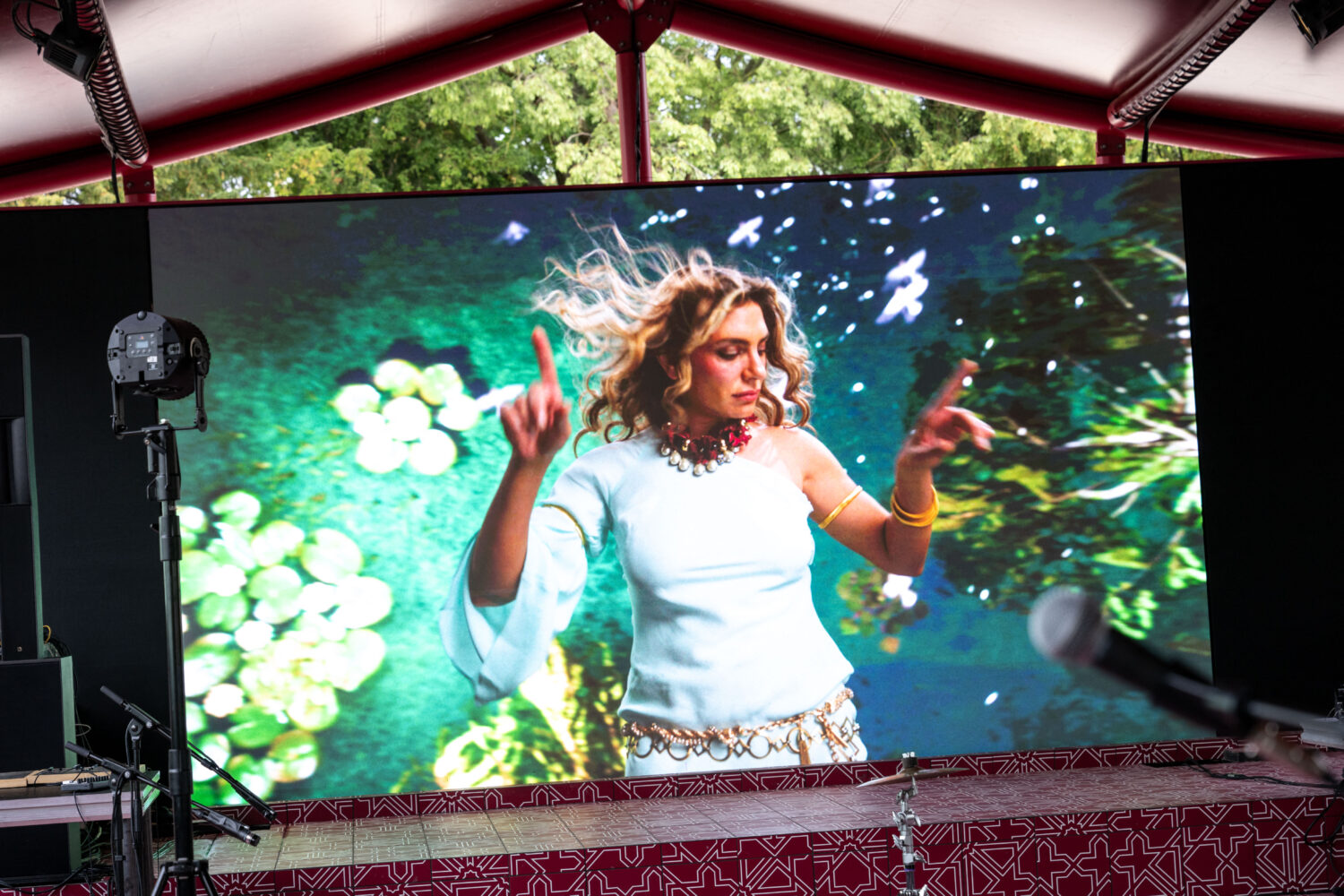
Al-Maria’s new experimental narrative film, DAMAR TV (2026), confronts media systems, memory, and the unstable boundary between witness and spectacle. The film follows television journalist Damar Darwish (played by Lebanese actress Yumna Marwan) after she loses her voice following an on-air altercation. Throughout the film, Damar encounters musicians including Fatima Al Qadiri, Dali de Saint Paul, Sarah Ourahmane, and Sulafa Elyas as she delves into the transformative possibilities of music and sound and imagines a more hopeful future.
Farid’s Jerrican (2026) is from her series of larger-than-life vessels used to store and carry water in the Gulf. Farid’s versions are enormous but hollow and light, molded in lacquered fiberglass and fabricated using the same method as the decorative casings for public drinking fountains that have become a distinctive feature of the urban landscape across the Arabian Gulf.
Produced by Qatar Museums and presented by Rubaiya Qatar (Qatar’s contemporary art quadrennial), a gathering of remarkable people is co-curated by Tom Eccles (Executive Director, Center for Curatorial Studies and the Hessel Museum of Art, Bard College) and Ruba Katrib (Chief Curator and Director of Curatorial Affairs, MoMA PS1).
Co-curators Tom Eccles and Ruba Katrib said, “This extraordinary exhibition is the result of a shared vision borne of tireless collaboration. Rirkrit Tiravanija, Sophia Al-Maria, Tarek Atoui, Alia Farid, Fadi Kattan, and the many performers and chefs working with them have created a cultural centre in the truest sense of the term, right in the heart of La Giardini della Biennale. a gathering of remarkable people is a genuine expression of culture’s ability to bridge our divides, which makes this project more urgent and timely than ever.”
Performance and Culinary Programme Schedule
Gathering of Remarkable People I (Vernissage and May 9)
An adaptive, durational musical performance punctuated by moments of silence and responding to archival sound and film will be accompanied by dishes served by Qatari and Gulf chefs reinterpreting traditional harees/jareesh, a traditional Middle Eastern comfort food made from slow-cooked cracked wheat.
With an approach to orchestration and ensemble-building that is closely related to Tarek Atoui’s project Revisiting Tarab, these arrangements are inspired by the structures of the takht (classical Arabic orchestra) and the wasla (a musical suite or sequence). Improvisation plays a major role, and the durational nature of the performance will echo how Arabic concerts historically took place.
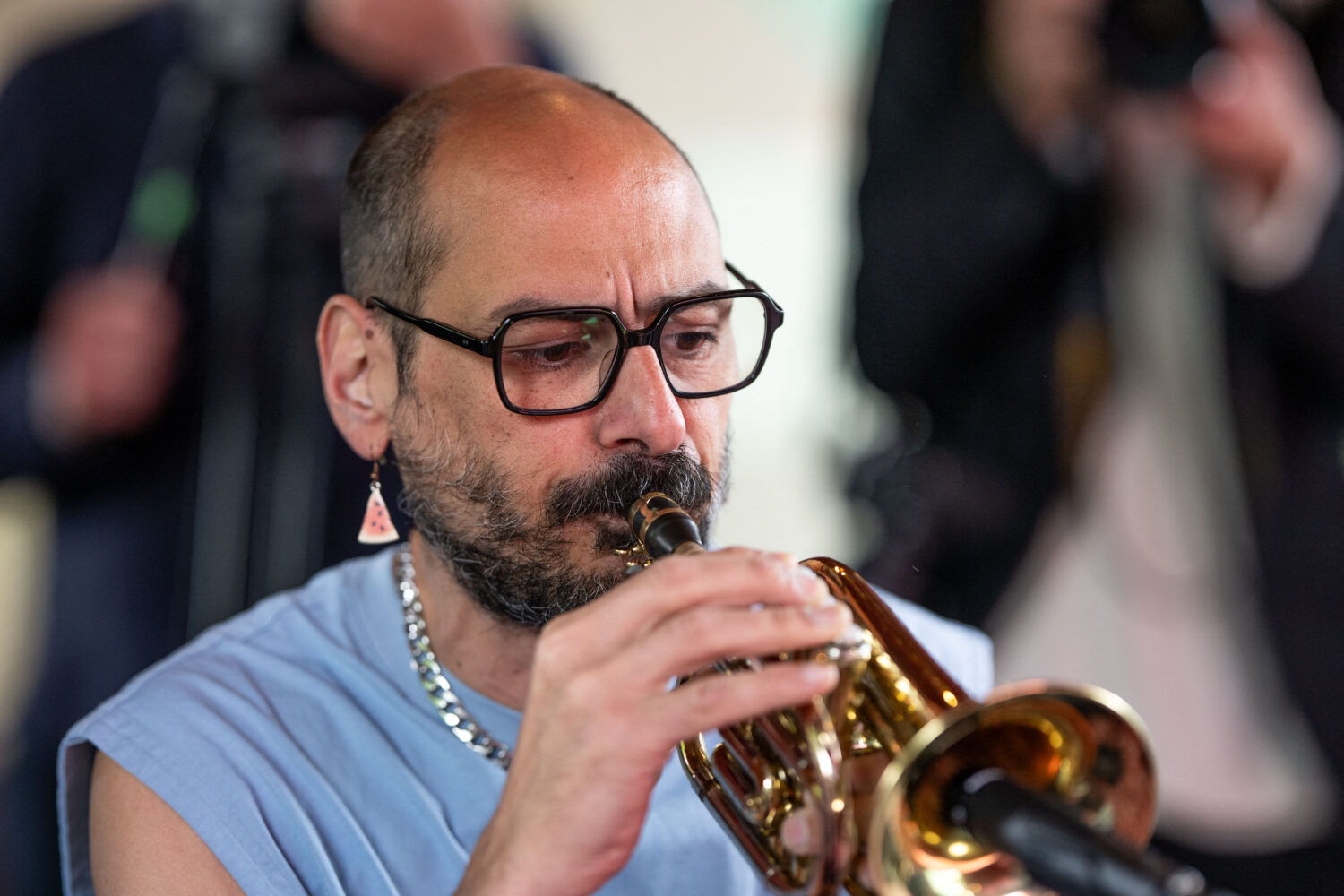
Musicians: Vivian Wang (voice/electronics, Switzerland/Singapore), Aya Metwaly (voice/electronics, Egypt/Switzerland), Gobi Drab (voice/flutes, Austria), Thomas Gouband (drums/percussion France), Mazen Kerbaj (trumpet/cracklesynth, Lebanon/Germany), Naghib Shanbehzadeh (percussion, Iran/France), Sara Ourahmane (cello/voice/electronics, Algeria/UK)
Chefs: Fadi Kattan (Palestine), Noof Al Marri (Qatar), Noor Murad (Bahrain), Majed Ali Almatrooshi (United Arab Emirates)
Mixologists: Anna Patrowicz (Poland/UK) and Vesta Kontrimaviciene (Lithuania) of Akub London
The 60s Collection I (June 13 and 14)
A group of electronic and experimental musicians will activate rare 1960s recordings from the archive of Paul Matar, a key figure of the Lebanese culture scene who traveled across the Middle East in the 1960s and 1970s as a sound recorder for films. Amid his travels, he spent significant time in the Gulf, meeting traditional musicians and recording their work while exchanging ideas about musical modalities and social rituals. The performance will respond to recordings made in Qatar in the late 1960s with rural musicians and ensembles. The culinary programme will be focused on land, grain, and mountain traditions.
Frame Drums (July 11 and 12)
Qatari percussion traditions will lead a cross-cultural musical exchange paired with a zero-waste, purpose-driven food program reflecting communal and inherited foodways.
The 60s Collection II (September 18 and 19)
Performers will present hip-hop and electronic interpretations of the Paul Matar archive alongside a culinary program centered on reinvention and reinterpretation of tradition.
Water’s Witness (October 10 and 11)
Field recordings captured by Tarek Atoui from Qatar’s coastline will be presented in listening sessions accompanied by street foods reflecting Doha’s multicultural culinary landscape. The performance is an extension of Atoui’s exhibition Water’s Witness, on view at Mathaf: Arab Museum of Modern Art in Doha (through May 18).
Poetry, Melody, and Text (October 31 and November 1)
Poetry and voice-led musical performances will be accompanied by an immersive exploration of coffee as a cultural cornerstone of Arabic hospitality.
Closing Week: Gathering of Remarkable People II (November)
Musicians and chefs will reconvene for a long-form ensemble performance marking culmination, continuity, and future extensions in Qatar.