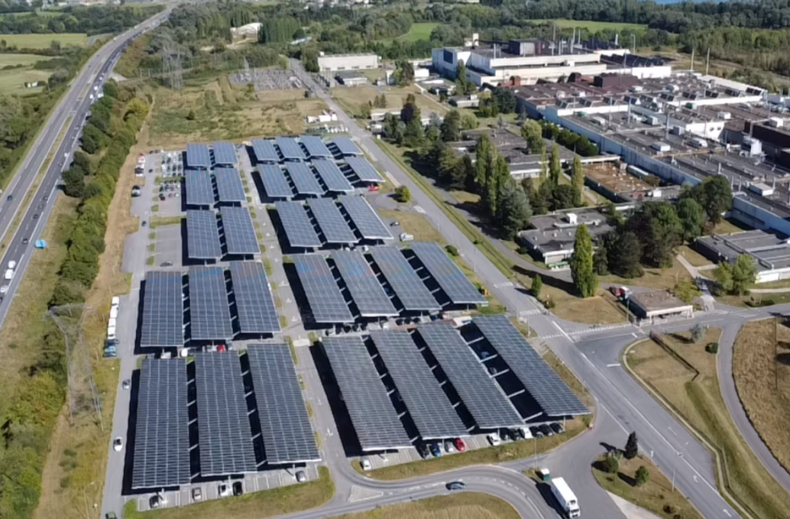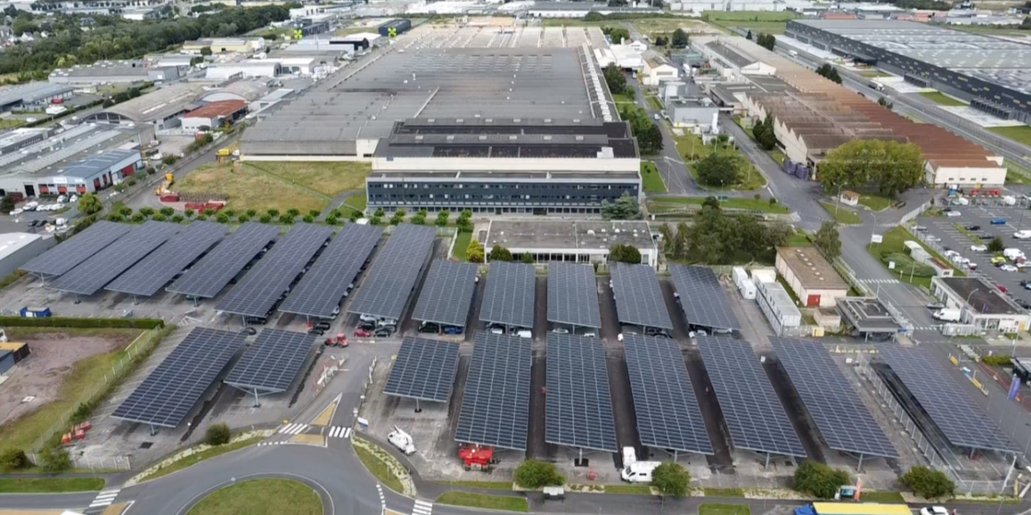
Stellantis has reached a major milestone in its decarbonization roadmap with the commissioning of three solar power plants at its French industrial sites. These projects have a threefold objective: reduce its exposure to fluctuations in energy prices, reduce CO₂ emissions linked to production activities and improve the comfort of employees and visitors thanks to the coverage of car parks.
Beyond the generation of green energy, these installations improve the use of already artificialized land, protect vehicles from weather conditions, reduce heat island effects, and enhance the daily on-site experience.
The deployment covers three key industrial hubs:
- Charleville (Ardennes): The largest of the three projects, with a capacity of 4.8 MWp spread over 7,741 PV panels. The plant will generate 4.5 GWh/year, equivalent to the annual consumption of +2,000 inhabitants and will avoid 252 tonnes of CO₂ per year.
- Valenciennes (North): A 4.6 MWp installation integrating 7,419 PV panels. It will generate more than 4.6 GWh/year, corresponding to the annual consumption of +2,000 inhabitants, and will contribute to reducing emissions by 256 tonnes of CO₂ each year.
- Caen (Calvados): With a capacity of 2.4 MWp, this power plant integrating 3,870 panels will generate nearly 2.3 GWh/year, equivalent to the annual consumption of +1,000 inhabitants, and allowing a reduction of 128 tonnes of CO₂ per year.
Overall, these self-consumption photovoltaic carport installations will avoid more than 630 tonnes of CO₂ each year, while securing part of the energy supply of the industrial sites.
Four other ground-mounted power plants for self-consumption are already under development, further strengthening the group's energy strategy.
This solarization program carried out with GreenYellow confirms the strategic role of self-consumption for Stellantis: local, sustainable and controlled energy, resilient to market fluctuations and serving both the Group’s industrial performance and environmental ambitions.
Mathieu CAMBET, Deputy General Manager of GreenYellow France: "This collaboration between Stellantis and GreenYellow demonstrates how industry and energy players can combine their expertise to accelerate the energy transition. These self-consumption solar power plants turn decarbonization objectives into concrete achievements by combining local energy generation and competitiveness."
A pan-European dynamic
Stellantis and GreenYellow share a common ambition to extend these initiatives across Europe, combining industrial performance, energy resilience and long-term decarbonization:
- In Spain (Madrid), Stellantis and GreenYellow have deployed a multimodal project on an unprecedented scale combining solar generation, electrification of thermal processes and energy storage. The ground-mounted photovoltaic power plant with a capacity of 4.6 MWp generates nearly 7 GWh/year for self-consumption and combined with rooftop solar installations, brings the total capacity to 12.9 MWp for a production of 18.8 GWh/year. This infrastructure alone reduces 931 tonnes of CO₂ per year. The site has also acquired the largest battery storage system (#BESS) in Europe dedicated to photovoltaic self-consumption, with a capacity of 25 MWh, guaranteeing better stability and optimal recovery of the energy generated. At the same time, energy efficiency actions on thermal processes make it possible to save an additional 2,500 MWh/year, strengthening the overall performance of the site.
- In Slovakia, a 13 MWp ground-mounted solar power plant, generating 15.7 GWh/year for self-consumption as part of a 17-year PPA, is part of the same dynamic.