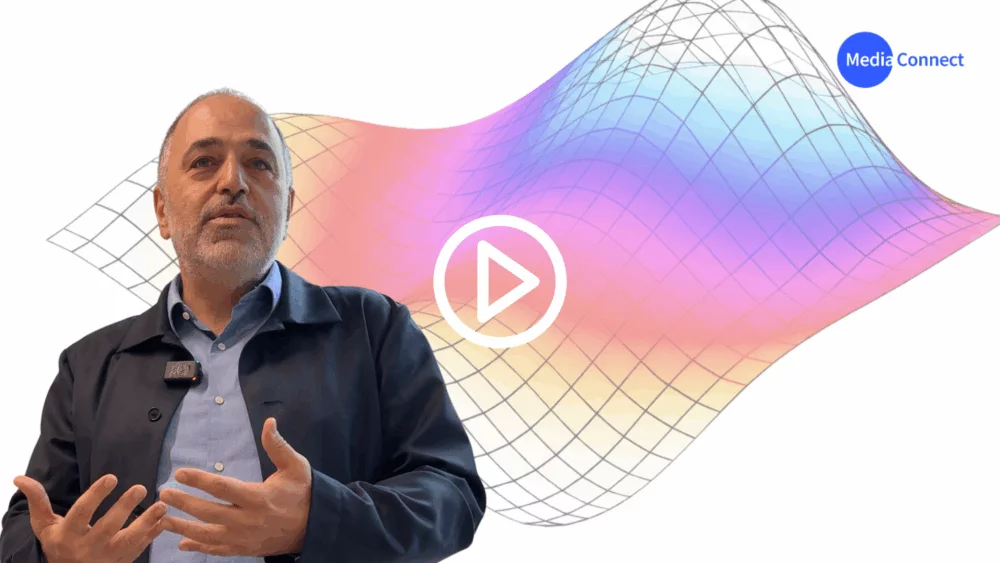
Can you start by presenting your role as a data journalist at INA?
My job is to lead the editorial development of data.ina.fr, while also creating formats for the various editorial teams at INA. Concretely, this ranges from writing investigations for La Revue des médias to developing editorial formats (videos, carousels) for social media, as well as collaborating with the team behind L'INAttendu, a show produced in partnership with France Info. I also handle the entire editorial spin-off of data.ina.fr, including the news barometer. Ultimately, most of my work involves using data to create editorial formats that help objectify how events are covered in the media.
What are the key issues around the use of AI in journalism? Would you say it’s more of a risk or an opportunity?
In my opinion, AI is primarily an opportunity for journalism. It allows us to investigate information spaces that were previously unexplored due to the volume of data involved. These tools can also generate predictions and probabilities. Even the best tools on the market are not 100% reliable and can produce biases and hallucinations. As these tools are increasingly used, public critical thinking about their outputs becomes more developed. This, in turn, helps to reassert the value of journalistic work: contextualizing and fact-checking, cross-verifying sources, etc.
The rise of AI is also pushing us toward greater transparency in our journalistic practices. Explaining how we arrive at a final result—whether or not AI was involved—helps demonstrate the added value of human input over AI.
Of course, there are risks, particularly when these technologies are trained with biases, used improperly, or treated as magical solutions. AI is algorithmic. And each AI algorithm is trained to perform a specific task. If a tool is used for a different task, the results can quickly become flawed, and using them becomes questionable or even problematic.
The rise of AI is also pushing us toward greater transparency in our journalistic practices. Explaining how we arrive at a final result—whether or not AI was involved—helps demonstrate the added value of human input over AI.
Of course, there are risks, particularly when these technologies are trained with biases, used improperly, or treated as magical solutions. AI is algorithmic. And each AI algorithm is trained to perform a specific task. If a tool is used for a different task, the results can quickly become flawed, and using them becomes questionable or even problematic.
You contributed to mapping the use of AI in newsrooms. What are the main applications in practice?
In this mapping project, we explored AI in a broad sense, including LLMs (Large Language Models), generative AI, and machine learning. The use cases are diverse and support all stages of information production and dissemination.
For collecting and preparing information, journalists can use conversational agents to explore a topic. This can be effective when they already have enough background knowledge to spot any false leads. AI tools can also help with transcription or automatically indexing information into a database, for example.
During the production and editing phase, these technologies can generate or retouch images and produce videos. They also contribute to fact-checking processes—like geolocating content or detecting AI-generated elements.
AI can also assist in writing, by optimizing an article’s SEO or adjusting its tone and angle to match the target audience. It can even improve content accessibility, such as by converting text to audio for visually impaired individuals.
Some tools truly support content creation—like data.ina.fr, the site where INA leverages AI to explore media.
For collecting and preparing information, journalists can use conversational agents to explore a topic. This can be effective when they already have enough background knowledge to spot any false leads. AI tools can also help with transcription or automatically indexing information into a database, for example.
During the production and editing phase, these technologies can generate or retouch images and produce videos. They also contribute to fact-checking processes—like geolocating content or detecting AI-generated elements.
AI can also assist in writing, by optimizing an article’s SEO or adjusting its tone and angle to match the target audience. It can even improve content accessibility, such as by converting text to audio for visually impaired individuals.
Some tools truly support content creation—like data.ina.fr, the site where INA leverages AI to explore media.
Let’s talk about data.ina.fr—can you present the project? What was the goal behind launching it?
Data.ina.fr is intended for the general public. By “general public,” we mainly mean people interested in the media and how they portray current events. In other words: journalists, researchers, news enthusiasts, teachers seeking media literacy resources for their students, and so on.
The project is built on two major pillars. First, objectifying information—a growing priority in today’s world. There is a real public demand for transparency around how information is produced and distributed, especially concerning media pluralism. Second, we aim to raise public awareness about AI. To do that, we’ve included warning messages on the site to flag anomalies detected in AI-generated results. The idea is to take an educational approach, providing users with tools to interpret AI-generated results and understand their biases and hallucinations.
On data.ina.fr, nearly 2 million hours of audiovisual archives have been analyzed, from January 1, 2015, to November 30, 2025. For comparison, someone living 100 years experiences 876,000 hours. Thanks to data journalism and data visualization techniques, combined with AI tools, anyone can explore this massive dataset. The site answers 16 questions using 28 charts and maps, all customizable. For example, you can ask which public figures were most frequently mentioned in the media over a given period and get a top 20 or top 10. You can also search for a specific person’s name. Through broad statistical trends, we can show media coverage of places and words, as well as gender balance in speaking time.
With data.ina.fr, we followed a rigorous and responsible approach, testing and selecting AI tools that best matched our editorial questions and journalistic standards.
The project is built on two major pillars. First, objectifying information—a growing priority in today’s world. There is a real public demand for transparency around how information is produced and distributed, especially concerning media pluralism. Second, we aim to raise public awareness about AI. To do that, we’ve included warning messages on the site to flag anomalies detected in AI-generated results. The idea is to take an educational approach, providing users with tools to interpret AI-generated results and understand their biases and hallucinations.
On data.ina.fr, nearly 2 million hours of audiovisual archives have been analyzed, from January 1, 2015, to November 30, 2025. For comparison, someone living 100 years experiences 876,000 hours. Thanks to data journalism and data visualization techniques, combined with AI tools, anyone can explore this massive dataset. The site answers 16 questions using 28 charts and maps, all customizable. For example, you can ask which public figures were most frequently mentioned in the media over a given period and get a top 20 or top 10. You can also search for a specific person’s name. Through broad statistical trends, we can show media coverage of places and words, as well as gender balance in speaking time.
With data.ina.fr, we followed a rigorous and responsible approach, testing and selecting AI tools that best matched our editorial questions and journalistic standards.
How can this tool be useful for communicators and/or journalists?
For communicators or strategic planners in charge of media monitoring, data.ina.fr is especially useful in identifying long-term trends.
Additionally, fellow journalists can use the site’s figures to create infographics, support on-air debates, or inform an editorial angle. For example, the local media outlet Médiacités used data.ina.fr to verify the media presence of Johanna Rolland, President of Nantes Métropole, and compare her coverage across different TV channels. This led them to conduct a deeper investigation.
In data journalism, numbers are meant to serve as a starting point for multiple stories and formats.
For media professionals, especially journalists, we also created the "Baromètre de l'actualité", published monthly since September 2025. It’s designed to inspire story ideas and share our findings. For instance, in the October edition, we compared media coverage of the trials of Marine Le Pen and Nicolas Sarkozy, channel by channel, during the four days following the verdicts. We discovered that some channels mentioned the former President more often than the RN MP. This kind of finding gives our peers a solid starting point.
Additionally, fellow journalists can use the site’s figures to create infographics, support on-air debates, or inform an editorial angle. For example, the local media outlet Médiacités used data.ina.fr to verify the media presence of Johanna Rolland, President of Nantes Métropole, and compare her coverage across different TV channels. This led them to conduct a deeper investigation.
In data journalism, numbers are meant to serve as a starting point for multiple stories and formats.
For media professionals, especially journalists, we also created the "Baromètre de l'actualité", published monthly since September 2025. It’s designed to inspire story ideas and share our findings. For instance, in the October edition, we compared media coverage of the trials of Marine Le Pen and Nicolas Sarkozy, channel by channel, during the four days following the verdicts. We discovered that some channels mentioned the former President more often than the RN MP. This kind of finding gives our peers a solid starting point.
Are these tools essential in today’s context?
In a context of growing public distrust toward the media, there’s a rising demand for transparency about how information is produced. We need to foster a more horizontal relationship between journalists and citizens.
So yes, these tools are important. As media professionals, we have a responsibility to examine our methods and how we work. I believe this kind of introspection will help strengthen journalism’s credibility. We must listen to the public—their needs and expectations—and strive to respond in the most rigorous and transparent way possible.
Ultimately, with data.ina.fr and its editorial extensions, our goal is to help as many people as possible understand and assess how audiovisual media cover the news.
So yes, these tools are important. As media professionals, we have a responsibility to examine our methods and how we work. I believe this kind of introspection will help strengthen journalism’s credibility. We must listen to the public—their needs and expectations—and strive to respond in the most rigorous and transparent way possible.
Ultimately, with data.ina.fr and its editorial extensions, our goal is to help as many people as possible understand and assess how audiovisual media cover the news.
In this article:
- What are the main uses of AI in newsrooms?
- Can AI improve journalistic transparency?
- What are the risks of using AI in the information landscape?
- Who is data.ina.fr intended for?
Also to read :