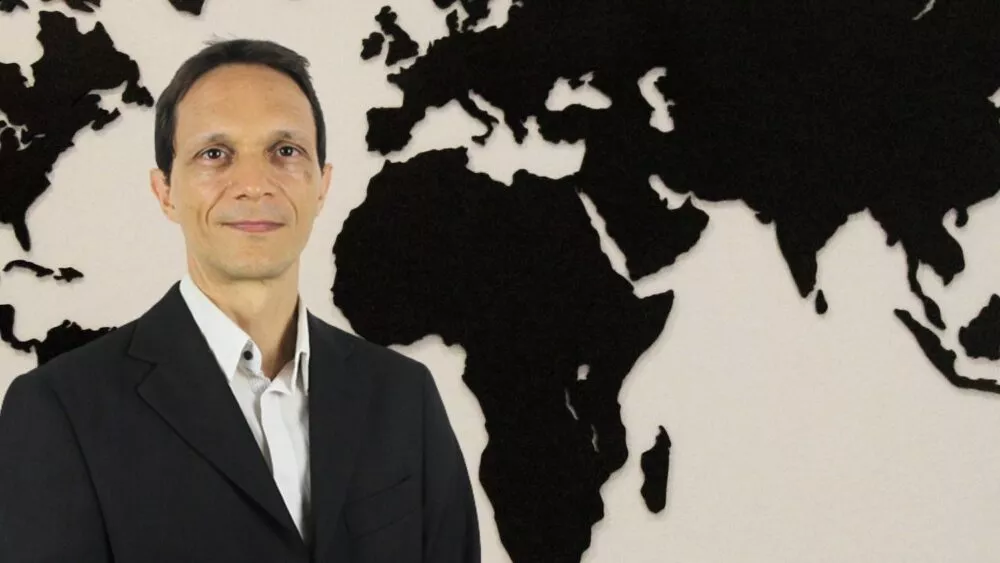
Could you introduce yourself and tell us about your career? How did you end up in PR?
I have a generalist background. After preparatory classes and business school, I started out in banking, in credit. I then worked as a trader on a trading floor, and later as the financial communications officer for that same floor.
I became an economic journalist in the professional banking and insurance press. I crossed to the other side of the mirror during the 2008 crisis, when I joined the French Banking Federation for its press relations. I then headed communications at Gras Savoye, and later at Planète CSCA.
For the past four and a half years, I have been at Sedgwick, an international network of experts. The expert is the person your insurer sends to assess the damage after a claim.
What qualities have you acquired through this career that are useful in your work today?
Press relations require you to be on call almost permanently for crisis management. I turn on the radio very early in the morning, and depending on the news, I may have to rush to the office. Some topics have to be handled before other media outlets pick them up.
Our profession demands staying calm while remaining responsive. You must be able to immediately mobilize the right people, make sure spokespeople are available and gather the resources needed for the press release. You can prepare a communication plan for the next six months, but you also have to be able to adapt to the unexpected.
My background also taught me what journalists need. Their concerns differ from those of a corporate communicator. Our content must be useful to them: figures, a contact who can provide the right quote, and so on. We must avoid burdening them with unusable communications.
Receiving better-targeted press releases is a recurring request from journalists in our “Clés des RP” series. But how do you stay up to date when newsrooms are constantly changing?
For my part, I work on a very specific subject. Even counting freelancers, the pool of journalists specializing in insurance is easy to keep track of. At a few major events during the year, I take the time to meet each of them. I ask where they stand, what they are working on and what their deadline constraints are.
Knowing whether a contact publishes online and needs the information before noon, or whether their deadline comes every three weeks, allows me to step in at the right time. Some prefer phone calls, others emails, others text messages. Knowing these habits makes it possible to adapt.
It is our job as communicators to know how to address this very particular audience. So I favor brief exchanges, by phone or text, because video calls are often disappointing. We no longer organize press conferences and rarely hold press lunches. Whenever possible, I offer exclusives to certain journalists.
What are your relationships with the different departments in your company? With your spokespeople?
Spokespeople understand our work, but they are rarely available because they are often in the field. For example, we had experts in Le Porge, in the crisis units. Our priority was to serve others rather than put ourselves forward.
In addition, senior management is cautious about public statements, because our claim files are often confidential. We therefore speak from an analytical angle rather than sharing feedback on a specific case. For instance, we prepared a blog article on the Fontainebleau forest fire, with an educational purpose for the training of future professionals.
How do you set up a PR strategy at Sedgwick? What are the differences between a B2B and a B2C strategy?
Sedgwick is the leader in claims adjusting in the United States. There, the network is the single point of entry for compensation related to the September 11, 2001 attacks. In France, we are only the sixth-largest network, facing competitors that have been established for much longer. My challenge is therefore to raise Sedgwick’s profile and to convince.
Most of our communications are B2B. We address informed journalists, who ask us about technical aspects such as timeframes or mechanisms. We have to adapt our message to their level of knowledge.
In B2C, the vocabulary must be very accessible. During the summer fires, we were published in Var-Matin. We gave practical advice, without necessarily promoting an insurer’s brand or our network. The aim was to explain the claim step by step and to support evacuees without adding stress to the situation.
My strategy is to move forward one small topic at a time until we are identified. I seek to be present at the right events and in the right media, in small touches, until calling us becomes a reflex. The day after the October 17 riots, for example, I contacted the newsrooms I know to offer them our figures. My goal is first to be available at the right moment and to give advice, not necessarily to seek visibility.
How do you reach journalists you don’t know?
I use the MediaConnect platform. I distribute my press release with keywords and topics, for example when we publish a study. Journalists subscribe to these themes themselves, so the information reaches them already close to their subject. I limit myself to three key ideas and an evocative headline.The platform is also useful to me at the European level. If I need to distribute a press release to the Nordic countries, the Netherlands or Germany, MediaConnect helps me reach the right journalists and coordinate everything.
What are the main challenges of your profession?
AI is raising a lot of questions right now. In the United States, Sedgwick’s PR team is fighting to ensure that no press release, paragraph or quote is written with AI. It found that search engines detect this content and do not rank it. This guideline is therefore being rolled out internationally.This illustrates the added value of our professions.
Knowing how to manage human relationships and the press is a differentiating factor for recruiters. Tools make it possible to master a large number of skills, but the ability to talk to a journalist is something you learn.
Finally, what advice would you give to a young communicator who wants to get started in PR?
You have to be passionate about the press. Sharing a passion for news with the journalist lets you truly understand their needs.I have a rather optimistic view of our professions: I have seen many tools arrive over time, and they have improved our daily work. But they remain tools. Press relations will not disappear.
To read also :
- Paul Parikhah (Île-de-France Mobilités): "Nothing ever replaces dialogue and exchange"
-
Media Relations: Why the Digital Press Room Is a Game-Changer
-
What Role Do Press Relations Play in Today’s Communications Departments?
To find out more, contact us and book an appointment.