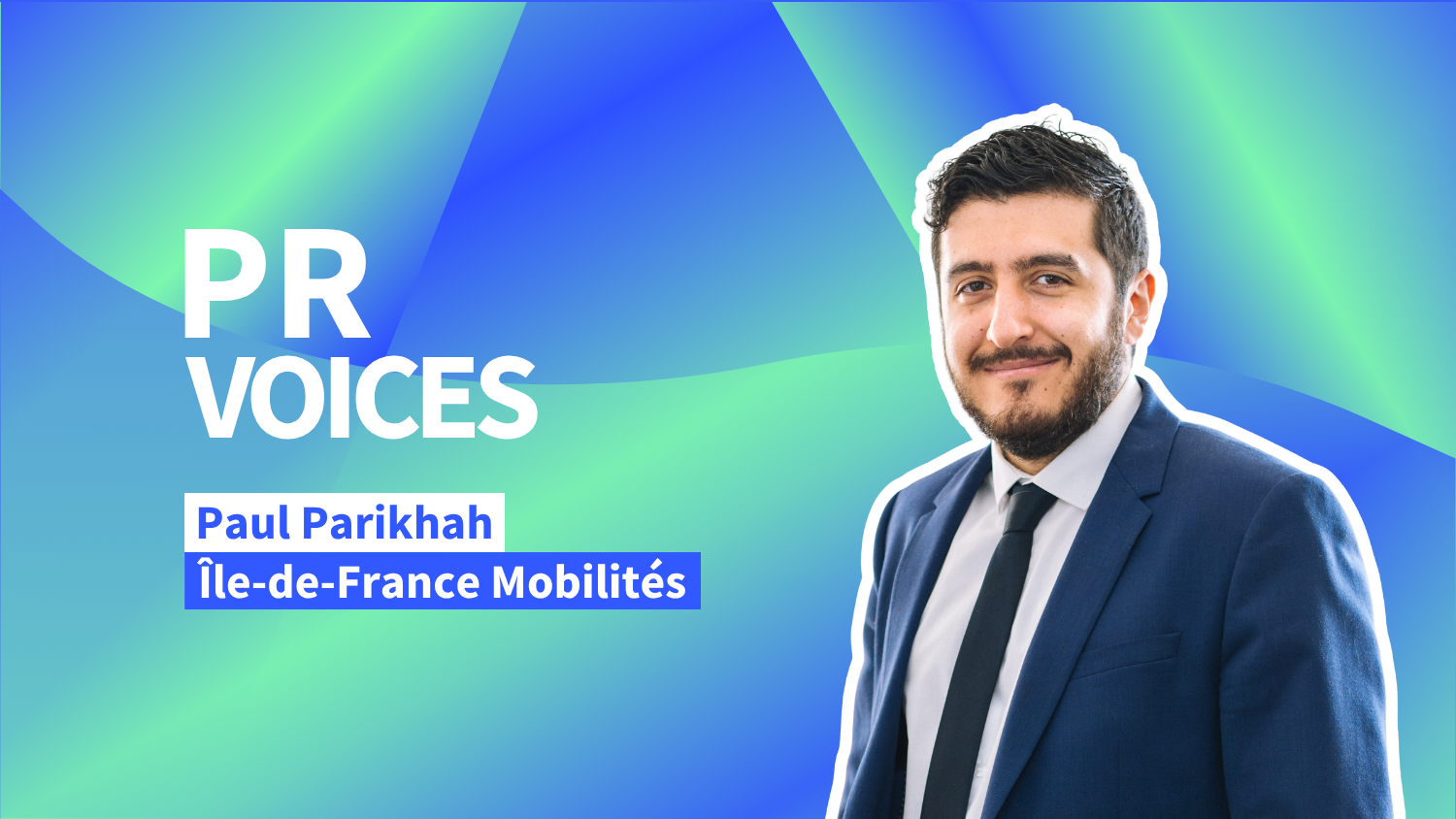
Could you tell us about your background? How did you get into communications and press relations?
I started with a bachelor's degree in history at the Sorbonne. At the time, I wanted to be a journalist, so I spent a year studying information and communication in my third year at Sorbonne Nouvelle. This led to a work-study placement in communications in the private sector, after I had discovered the communications professions. I quickly realised that I was more drawn to public service, with a genuine desire to be useful to my fellow citizens. After this first professional experience, I sat the entrance exam for the Master's in Political and Public Communication at Celsa. I passed, and then did my end-of-year internship in the communications department of the Conseil d'État, where I discovered press relations. Being constantly in touch with the news fascinated me.
I then worked for a few months at Kantar (now Onclusive) as a media monitoring officer before returning to the Conseil d'État. I stayed there for about six years before being recruited by the Paris Police Prefecture as deputy head of the press office in 2022. I joined Île-de-France Mobilités in 2024 as Head of Press and Social Media.
My career has been shaped by encounters and opportunities. I was heading for journalism and knew nothing about the communications professions. I then discovered that communicators are an essential link in the information chain, particularly in the public sector. The information we handle serves the greatest number of people.
In your view, what are the three essential qualities of a good PR officer?
The first is responsiveness. Ours is a very intense profession, so you have to be responsive, adaptable and flexible. A good communicator must be able to switch from one subject to another in two minutes.You also need to enjoy understanding and summarising sometimes complex subjects. Communicators are the institution's window on the outside world. I have worked with lawyers, engineers and police officers: the whole challenge is to build a message that is clear, easy to understand and useful to citizens.
Finally, rigour is of course essential, to avoid spreading any false information.
What is your relationship with other internal departments? To what extent have you ever felt you had to justify the value of PR?
Over the course of my career, most of the people I have worked with have understood the importance of having an experienced communications department. I have come across some people who considered our profession superfluous, so it has sometimes been necessary to change mindsets.At Île-de-France Mobilités, however, all staff understand the value of communication. Our work is part of the daily lives of people in the Île-de-France region. We are visible every day. If there is an incident on the network, everyone sees it. If a bus is not running, passengers contact us. We receive requests from the press to explain a breakdown on the metro. Whether in PR or on social media, we meet a concrete need.
What are your communication challenges at Île-de-France Mobilités?
Today, we are increasingly visible. The brand is being rolled out across the Île-de-France region, as the transport network opens up to competition. The goal is to make it part of residents' daily lives: one network, one fare, one point of contact. We are also building this reflex with journalists, so that they contact us.The PR challenge is to broaden our reach beyond journalists who specialise in transport. Our topics directly affect readers' daily lives, and newsrooms approach us a great deal. Even very local news, such as a new bus stop, always finds an interested journalist. Media outlets are indeed increasingly interested in their audience's daily lives. Conversely, in-depth topics struggle to attract media attention when there are no images to film or no concrete new developments.
Given current trends, what are the challenges in your profession?
I see three main challenges.The first is the acceleration of the news cycle, to which we are all starting to adapt. Today, you come out of a meeting with a passenger association and the information is already in the press before you have had time to react. Social media requires ever greater anticipation.
The second is a little more problematic: the loss of trust in institutions, which seems fairly lasting. Our aim is to work genuinely on the transparency of our public statements, as well as on verifying the information that is published. Information that appears on social media is not necessarily true, even though a tweet can sometimes carry as much weight as a statement from an institution. This is a deep crisis, and we have a role to play in restoring citizens' trust in the public, political and institutional world.
Finally, we are seeing traditional media lose ground to social media and content creators. When I was younger, a story would appear on the 8 p.m. TV news, and you knew that one in six French people had seen it. Today, it is one in fifteen. As communicators, we now have to segment our messages by media outlet, and therefore by audience. We can no longer address everyone in the same way.
This reshaping of the media landscape is also leading to a decline in the number of local media outlets in the Île-de-France region. Paris is home to the major national and international media, so your local news does not necessarily interest Paris-based journalists.
How do you maintain good relationships with such a diverse range of journalists with different needs?
It's a real challenge. The simplest approach is obviously to meet them in person, but we cannot see them every day. Time constraints prevent us from organising regular face-to-face exchanges. Most often, we meet them after press conferences or field visits, where they share their requests with us. Otherwise, you have to take the time to talk on the phone and adapt to their needs. In general, we have one or two contacts per media outlet with whom we maintain a relationship and who serve as our gateways.For example, TV channels do not have the same needs as the print press, which can cover longer, more in-depth topics. TV journalists need images and concrete subjects for reports.
Our challenge is to find the right way into these media outlets. It can sometimes be difficult to identify the specific topics each one covers. PR tools can help, but in my view, nothing ever replaces dialogue and exchange.
Read also
- Bénédicte Chalumeau-Vignon (AFFLELOU Group): “A public relations strategy is truly effective only when it combines performance with relevance.”
- How to effectively target journalists when distributing a press release ?
- Fake news: the new strategic risk for companies
To find out more, contact us and book an appointment.